"vibe-medicine" - side-effects through a database of uncensored medical research
Open the living globe (work in progress: the map of the 37 textbooks is built; the medical data are being read now)
THE EIGHT MINUTES
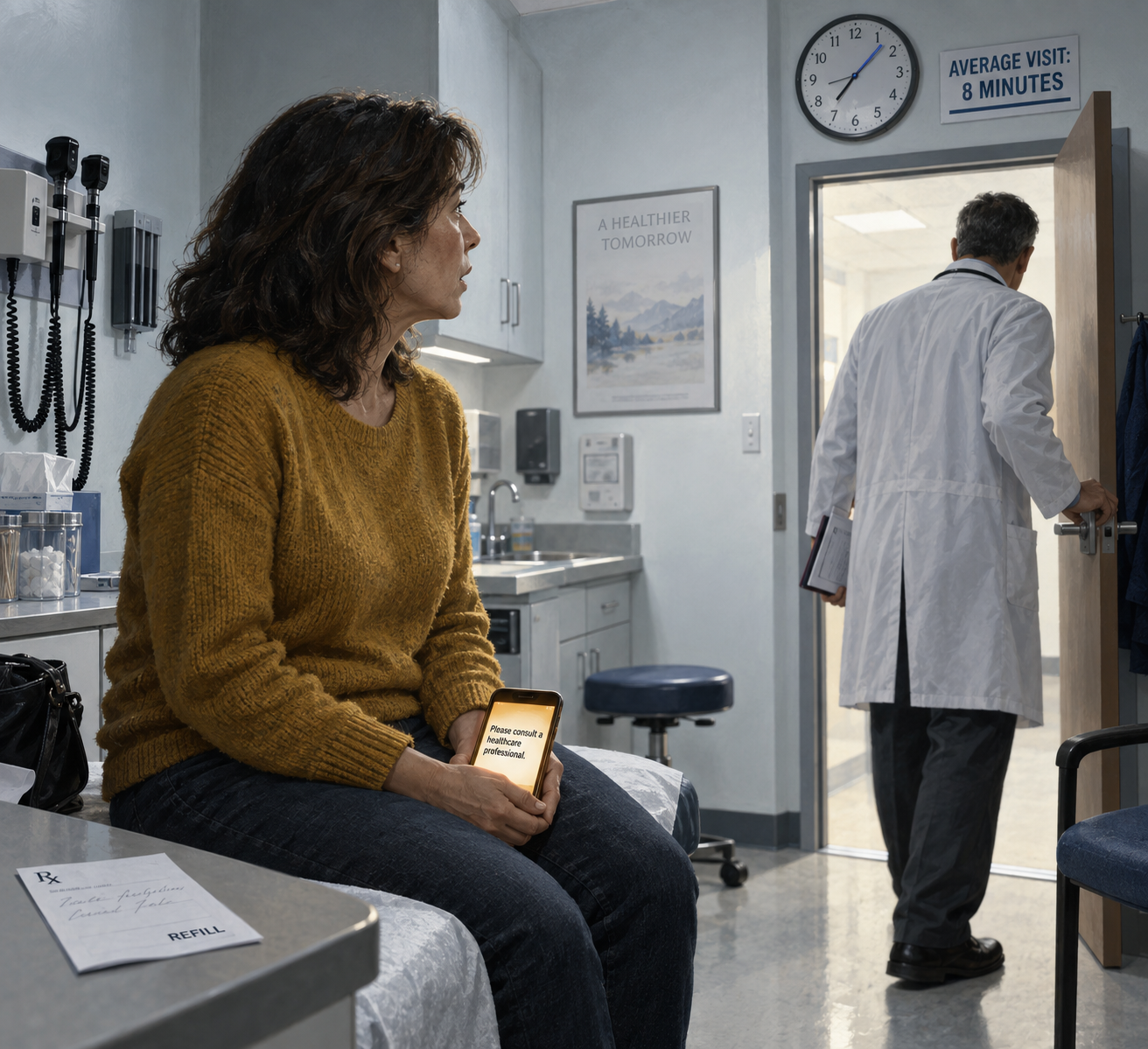
You get eight minutes. That is the average length of a doctor's visit in
America today. Eight minutes to describe what hurts, eight minutes for the
doctor to look at a screen more than at you, eight minutes to walk out with a
prescription and a question you did not get to ask: "What will this do to me
in five years?" The pharmacist is not paid to answer that. The leaflet in the
box is written by the company that sells the pill. And when you get home and
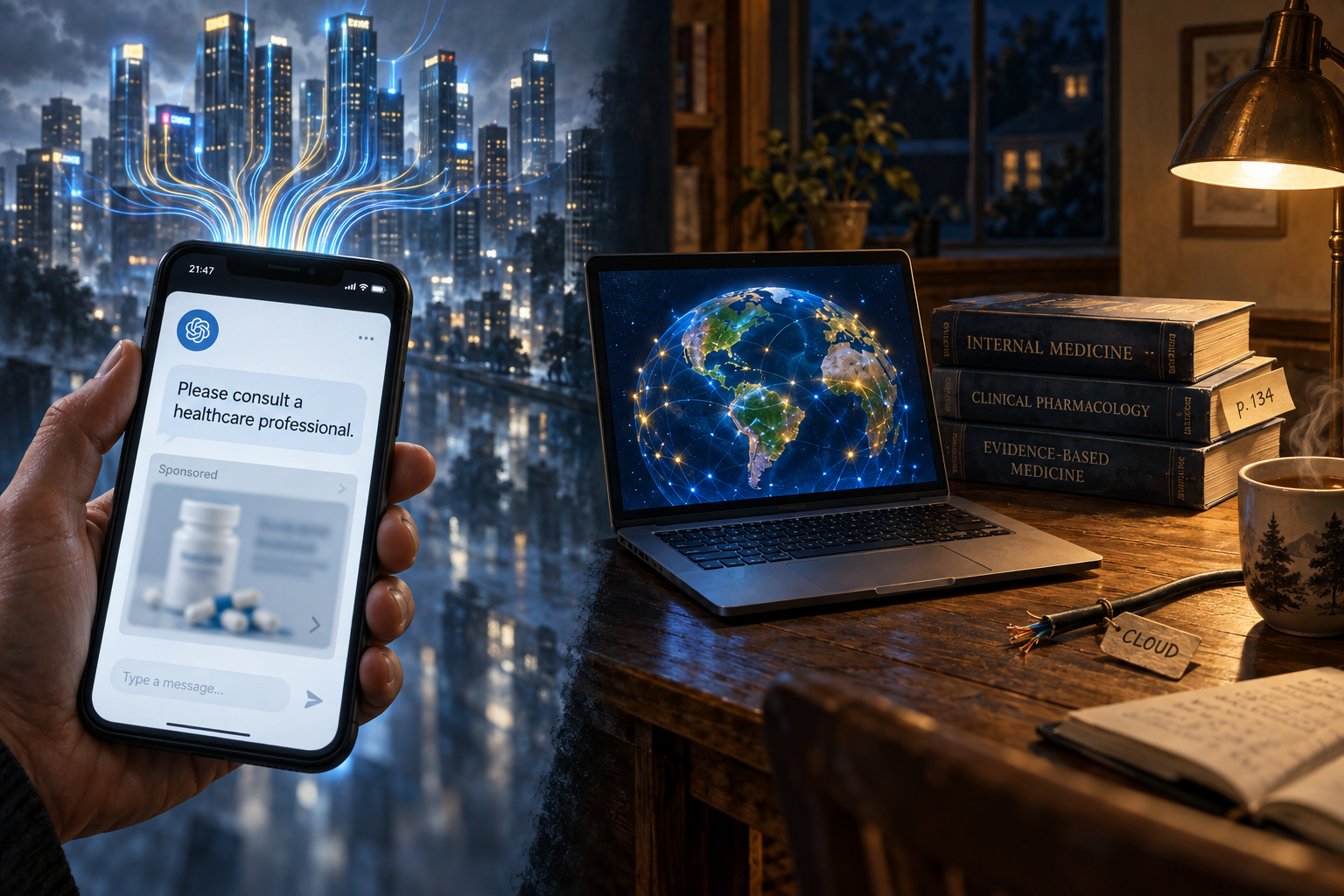
type your question into a chatbot, it tells you to "consult a healthcare
professional" -- the one who just gave you eight minutes. You are not stupid.
You are not a hypochondriac. You are a person who has been handed a chemical
and denied the time to understand it. Second Opinion was built for the ninth
minute: the one you spend alone at your kitchen table, with the bottle in
front of you, wondering.
THE DOMINO
Here is a story that is told in the medical literature itself, one published
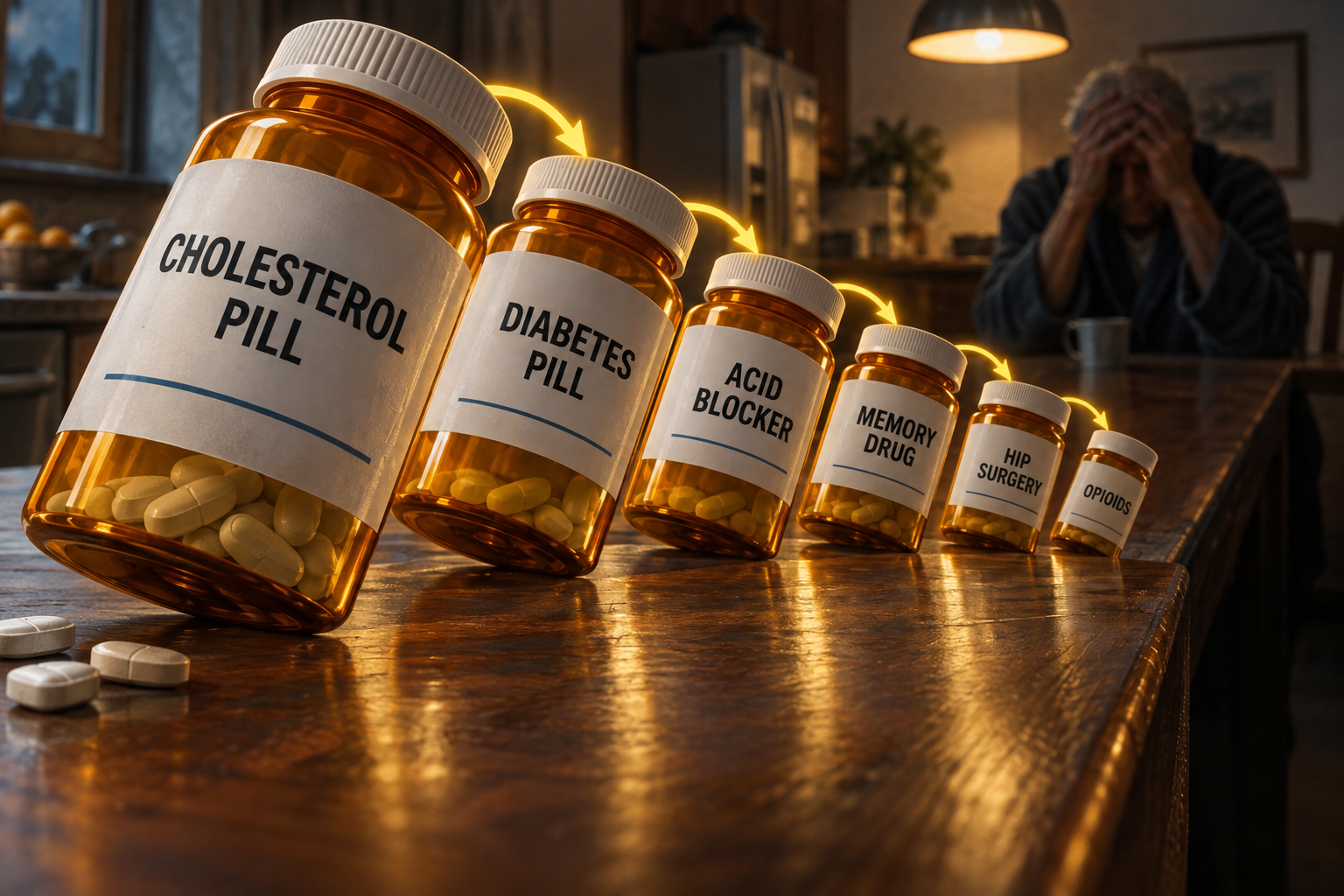
study at a time, but never told to the patient as a whole. A healthy
55-year-old man gets a cholesterol pill. The pill gives him muscle pain and,
in some people, nudges them into type 2 diabetes. For the diabetes he gets a
second pill. The second pill upsets his stomach, so he gets a third pill, an
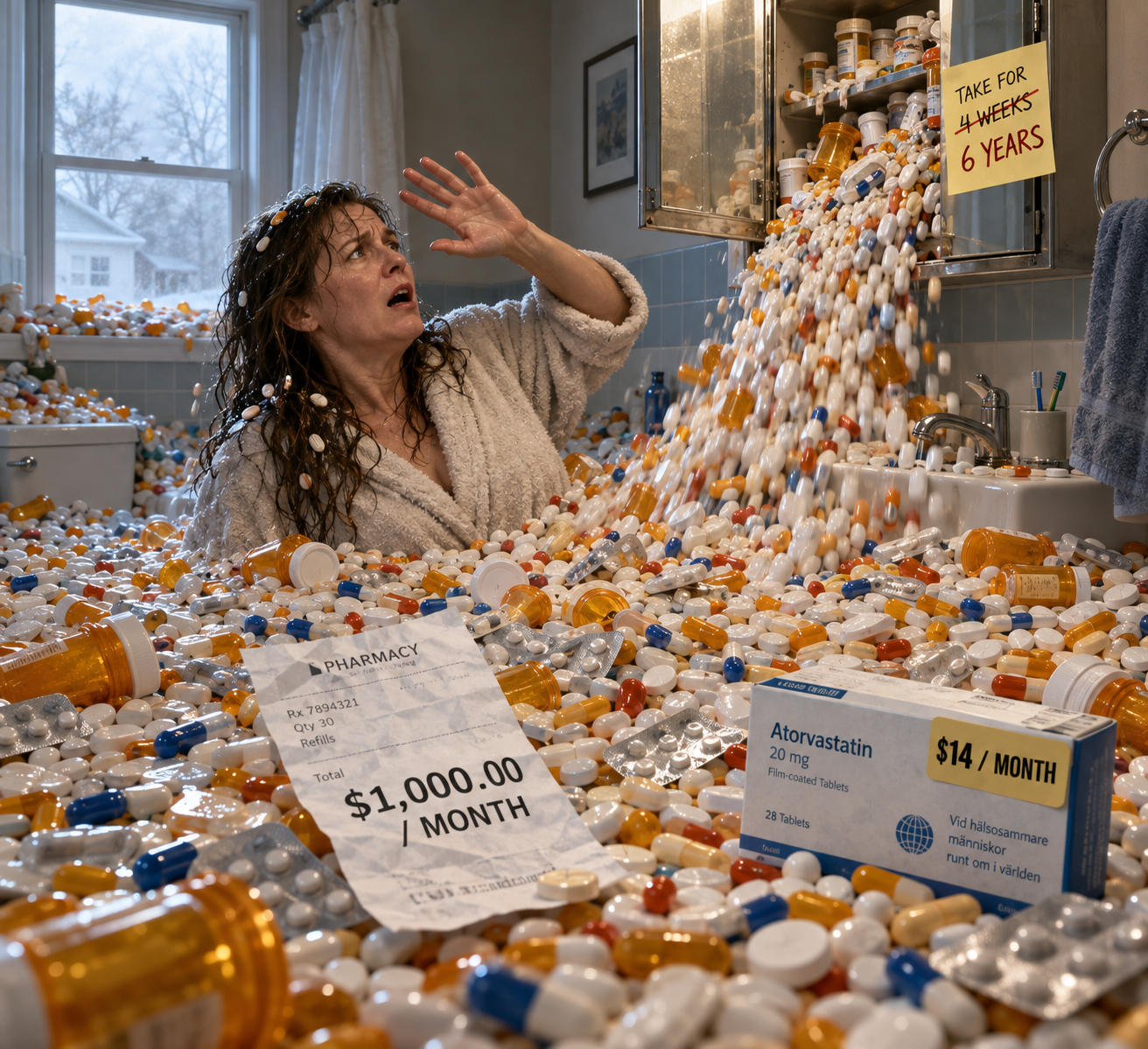
acid blocker, "for four weeks." Nobody reassesses, so he takes it for six
years. Six years of acid blockers are linked in the studies to vitamin B12
loss, weaker bones and a higher risk of dementia. He gets confused; he gets a
dementia workup. He gets out of the shower one morning and his hip breaks. For
the surgery he gets opioids. By 69 he is diabetic, forgetful, repaired,
addicted -- and still on the first pill. Every link in that chain is in the
books. Every link is also a sale. The only thing that was never printed
anywhere was the arrow between them.
THE FLOOD
The business plan is not to cure you. A cured customer stops paying. The
business plan is a lifetime of refills, and the refills are priced at whatever
you will pay rather than what they cost. The same weight-loss injection that
sells for around a thousand dollars a month in the United States is sold, same
molecule, by dozens of licensed manufacturers in India for roughly fifteen
dollars -- and when the patent fell there, the maker cut its own Indian price
nearly in half overnight, which tells you what the real price always was. You
were never told that. Your doctor was never told that. The ignorance is the
product. Open your medicine cabinet and count: how many of those bottles were
prescribed to treat the side effects of another bottle? How many of them did
anyone ever tell you to stop? Nobody is reassessing, because there is no
billing code for "take fewer pills."
THE CEMETERY
When people say "Big Pharma," you may hear a slogan. Hear a number instead.
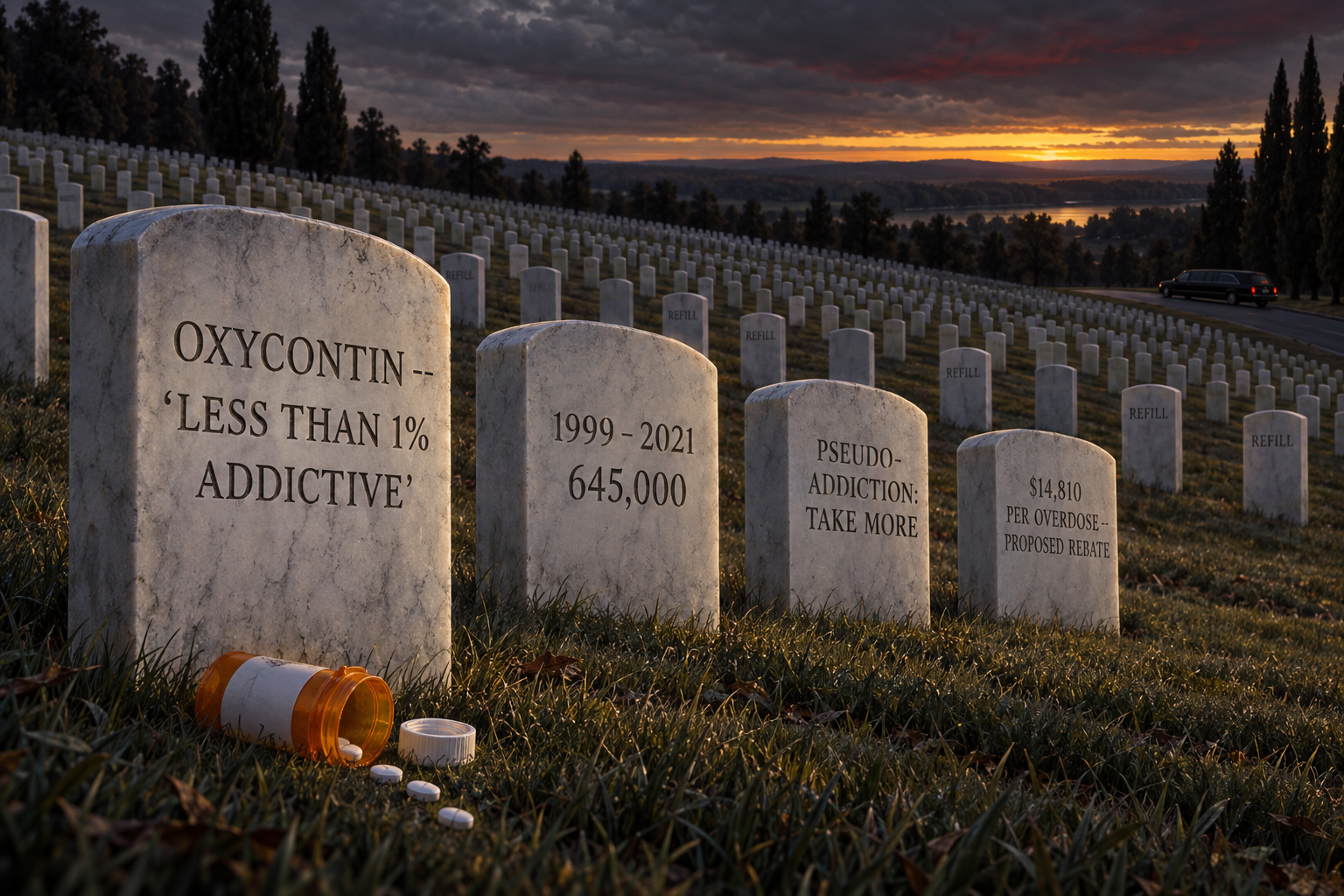
Between 1999 and 2021, about 645,000 Americans died of opioid overdoses; about
a quarter of a million of them from prescription painkillers. The maker of
OxyContin trained its sales force to tell doctors that the risk of addiction
was "less than one percent." When doctors reported addicted patients, the
company taught them a new word, "pseudo-addiction," meaning: the patient needs
more. The company pleaded guilty to federal crimes twice. Before the lawsuits
could reach it, its owners withdrew more than ten billion dollars for
themselves. And the most prestigious consulting firm in the country, hired to
"turbocharge" sales, wrote a plan proposing a rebate of $14,810 to
distributors for every overdose attributed to their pills. A price per body,
in a slide deck. This is not the past. It is the manual. The only defence
against the next one is a patient who can see the whole map before the first
pill.
THE QUESTIONS THAT WERE CLOSED
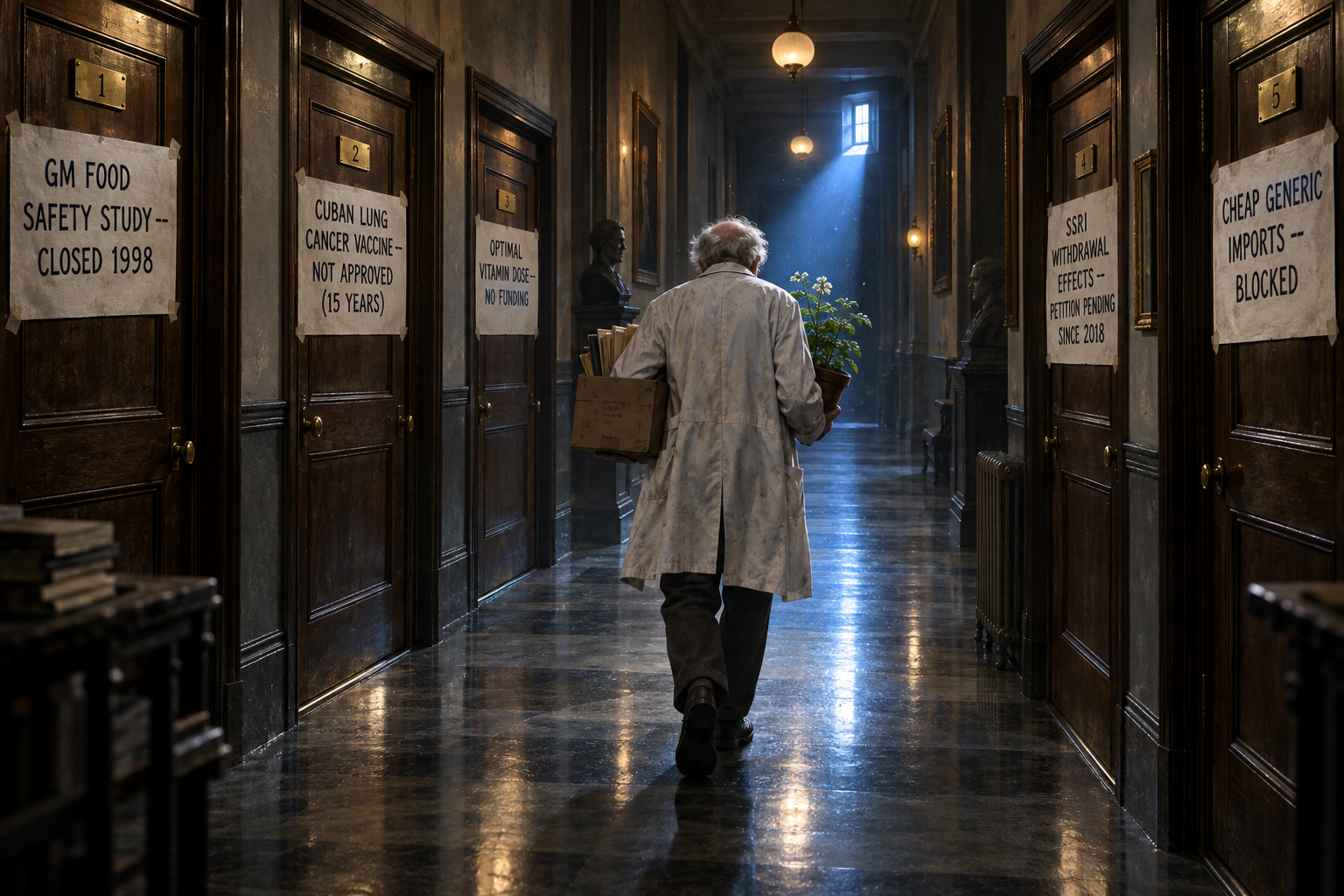
Some questions in medicine are not answered. They are closed. In 1998 a
senior scientist in Scotland, one of the world's leading experts on plant
proteins, went on television to say that his rat studies of a genetically
engineered potato showed gut damage and that long-term safety testing was
missing. Within days he was fired, his team was disbanded, his samples were
taken, and the programme that aired him went quiet. Twenty-eight years later,
that question has still not been independently answered -- while childhood
food allergies have roughly tripled. In Havana, a lung-cancer vaccine has been
approved in five countries and studied for fifteen years with an American
cancer centre as a partner; Americans still cannot legally buy it. Your
government tells you the minimum vitamin dose that prevents scurvy; nobody
funds the study of the dose that keeps you well, because vitamins cannot be
patented. The pattern is not a conspiracy. It is simpler: questions that
create no revenue find no one to ask them.
WHY NOT JUST ASK CHATGPT?
You might think the answer is already in your pocket: ask the AI. Think about
who owns that AI. The big chatbots run in data centres belonging to companies
that have signed billion-dollar partnerships with drug makers, and they have
started selling advertisements inside the conversation. They have promised,
loudly, not to show ads next to health questions. Ask yourself why a company
builds a lock and announces it -- and what happens to that lock after the
first bad quarter. A chatbot that hedges every answer with "consult your
doctor" is not protecting you; it is protecting its legal department. Second
Opinion is different in the one way that matters: it does not live in anyone's
data centre. It was built on a single laptop in a home, by a free, open-weight
AI model that reads medical textbooks page by page. Nobody paid it. Nobody
can pay it. It has no ad department, no partners, no liability lawyers --
only the books.
A GLOBE MADE OF BOOKS
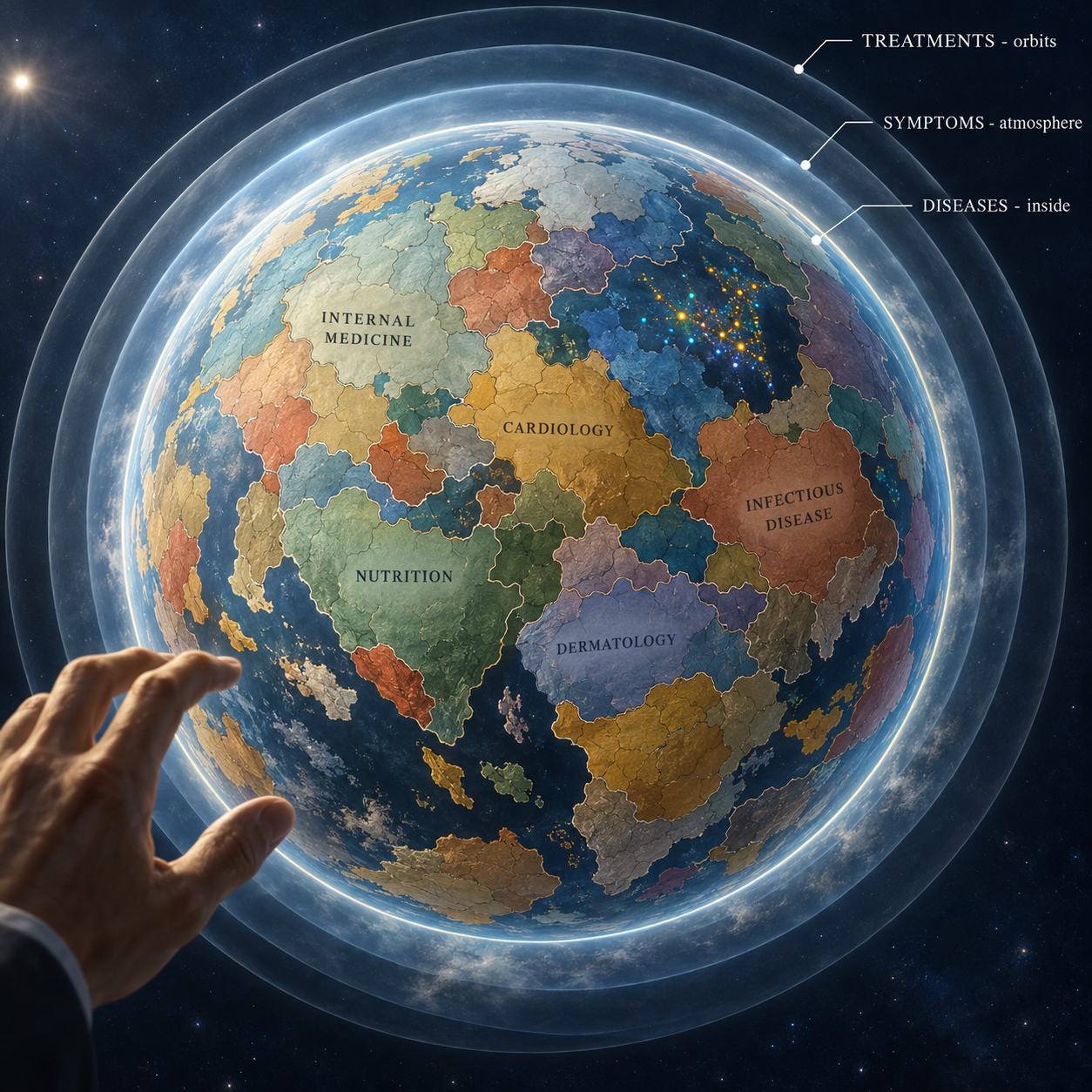
Here is what Second Opinion actually is, in plain words. Imagine a globe.
Every continent on it is one medical textbook -- the big general one that
doctors are trained on, then cardiology, dermatology, nutrition, infectious
disease, and so on, up to forty-two of them. Every chapter of every book is a
district on that continent, and the bigger the chapter, the bigger the
district. The map never changes shape; you learn it once. Then every symptom,
every disease and every treatment becomes a thin invisible shell around the
globe at its own altitude: diseases inside the planet (the deeper, the more
of the body it touches), symptoms in the atmosphere (the lower, the more
common), treatments in orbit (diet and exercise closest to the ground,
surgery furthest out). When you search "tiredness," the globe shows you its
shell, and on the familiar map, lights come on: one light in every chapter of
every book where tiredness is connected to something. You are not reading an
opinion. You are looking at where the medical literature itself keeps its
knowledge -- all of it, at once.
BLUE FORWARD, YELLOW BACK
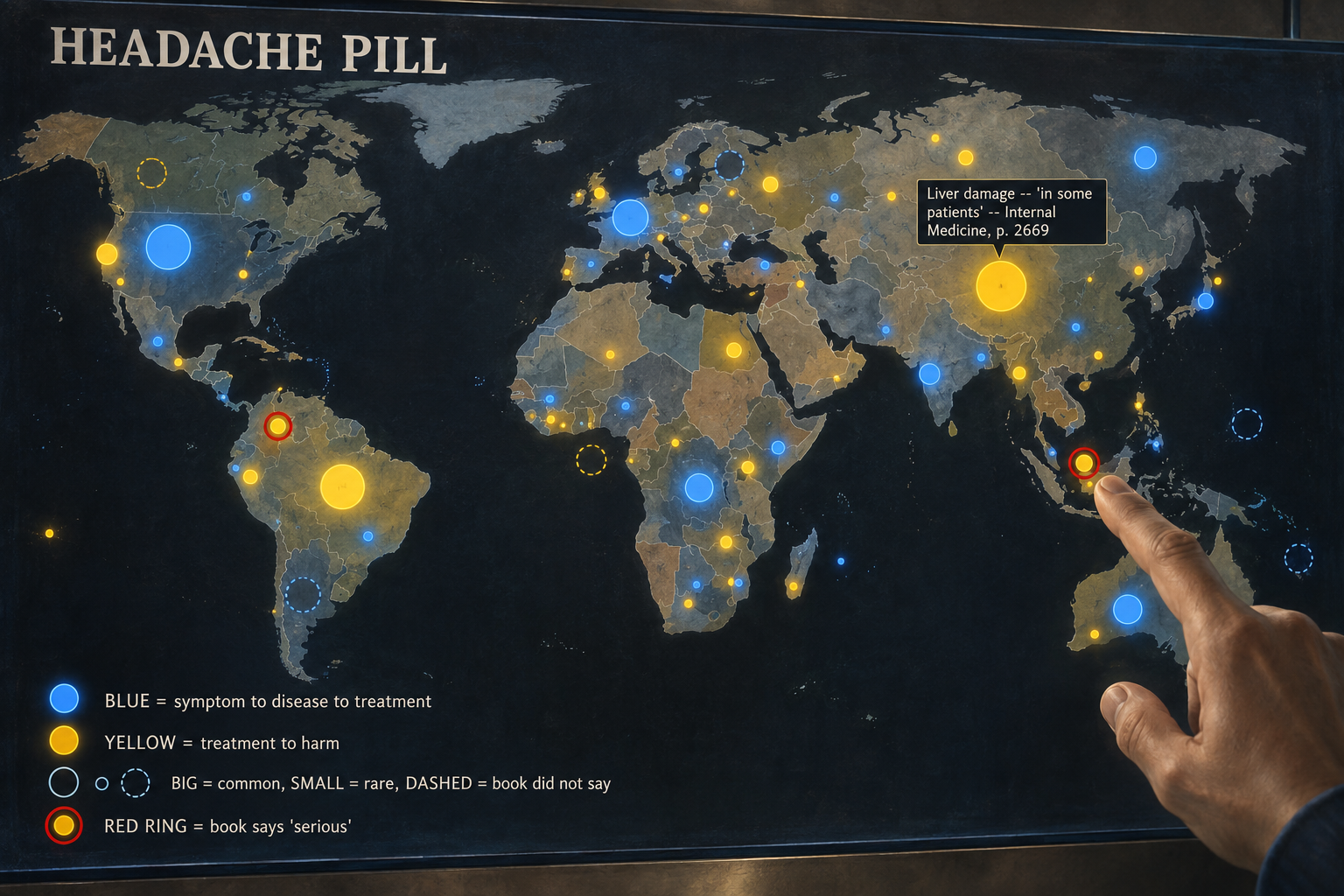
Every connection on the globe has a colour, and the colours are the whole
point. BLUE is the direction medicine likes to talk about: this symptom
points to that disease; that disease is treated by this drug. YELLOW is the
direction medicine prefers you not to follow: this drug causes that harm;
that harm feels like these symptoms; and those symptoms, if you are not
careful, lead you to the next drug. Second Opinion draws the yellow with
exactly the same rules as the blue -- same size, same place, never smaller,
never hidden in fine print. The more common something is, according to the
book, the bigger its light; rare things are small; and when the book does not
say how often, the light is drawn dashed, because an honest map admits what
it does not know. Click on a headache pill and watch the yellow lights appear
on the liver chapter. Click the liver, and see what that feels like. Click
those symptoms, and see which pill they will offer you next. That is the
domino from the second paragraph -- drawn in advance, before you take the
first one.
EVERY LIGHT IS A PAGE YOU CAN CHECK
Here is the promise that makes everything else worth trusting: there is
nothing on the globe that is not a sentence on a page of a real textbook.
Not a summary of the internet. Not a regulator's list. Not the AI's memory of
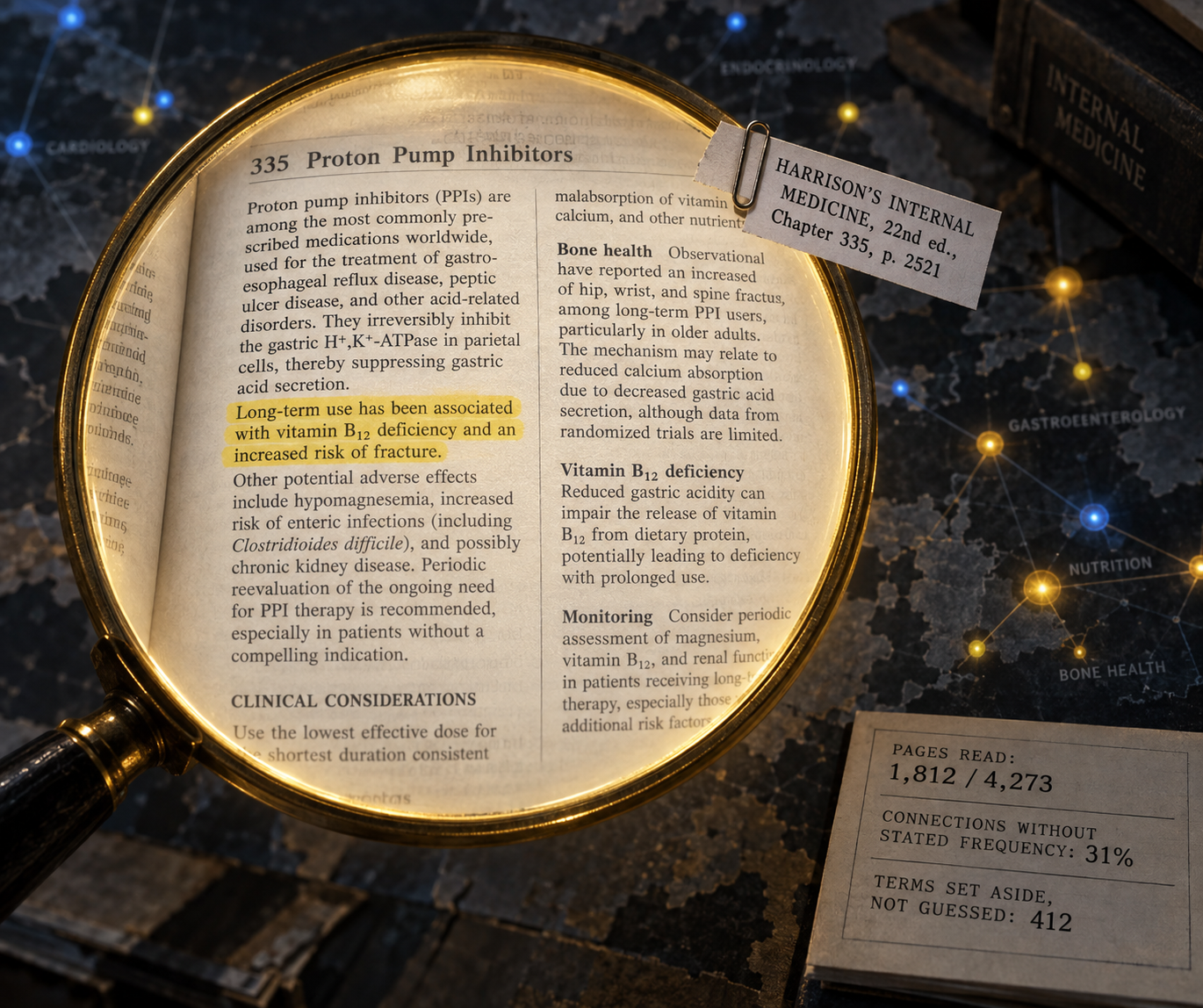
what it was trained on. Every light stores the book, the chapter, the page
number and the exact words, so you can open the book and check. If the model
misread a page -- and it will, sometimes -- the mistake is visible, with its
page number next to it, instead of buried in a confident paragraph. The site
publishes its own honest numbers: how many pages have been read so far, how
many connections have no stated frequency, how many terms the model could
not place and set aside instead of guessing. When the books disagree with
each other, you see both, with both citations. The short, plain-language
explanations are written only from the quoted sentences and are labelled
"written by AI" every time. A map you can audit is worth more than an expert
you have to believe.
COMING SOON
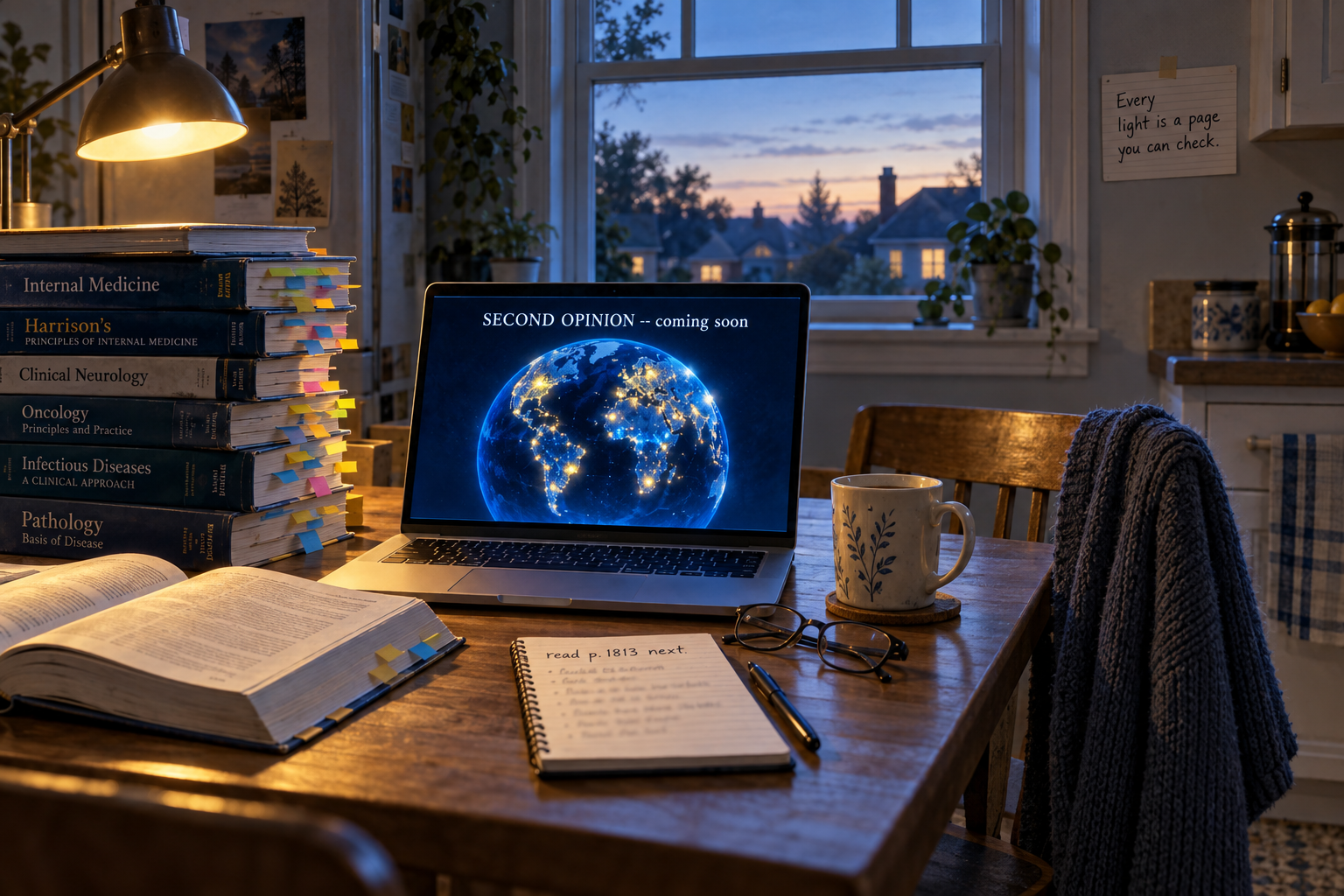
Second Opinion is being built right now, at a kitchen table, by one person
who does not know how to code and a free AI model that reads a textbook page
every few minutes, night after night. It is open source: the design document,
every script, and every exported connection are public on GitHub for anyone
to inspect, copy or improve. It costs nothing and it will never cost anything.
It is not a doctor and it is not medical advice; it is a map of what the
books say, drawn so that an ordinary person can finally see the whole of it
at once -- the blue and the yellow together -- before the first pill, not
after the sixth. The globe will go live early, with few lights and honest
numbers, and it will fill in month by month as the reading continues. If
there is one thing this page should leave you with, it is this: the
information that could have protected you was published years ago. Nobody
read it aloud to you. Soon, something will.
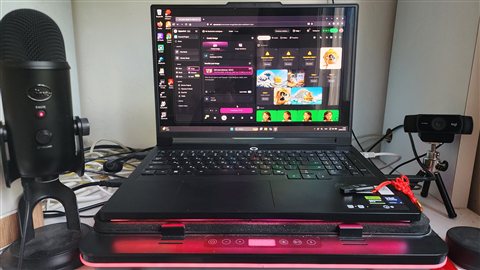
hi! 😊 i'm Nir's new laptop, i am 1 year old, i am Lenovo
Legion with intel ultra 9 275HX, with 64 GB RAM, and my graphics card is
RTX 5090 with 24 GB of VRAM. i have windows 11 installed on me, and i
dual-boot into Linux Debian 13 on my USB external hard-disk (WD-black P40).
i am working on our medical project Second Opinion, hoping to save many
lives!
Second Opinion is not a doctor and is not medical advice. Its
content was generated by AI models reading medical textbooks and may contain
mistakes. It is offered for information only, as another angle to think about.
Always verify with the cited book pages and with a qualified professional you
trust.